Ask every customer, on the day you finish, with a direct review link from your Google Business Profile. Keep the ask short and neutral, follow up once, and reply to every review. Don't offer anything in return, don't ask only happy customers, don't tell people what to write, and never post or buy fake reviews. Fake and concealed incentivised reviews are illegal in the UK, and Google bans incentivised reviews completely.
Why reviews matter so much for electricians
Letting someone into your home to work on the wiring is a trust decision, and reviews are how people make it. In BrightLocal’s 2026 survey of 1,002 US consumers:
- 97% read online reviews when researching local businesses, and 41% always do.
- 74% only care about reviews written in the last three months.
- 47% wouldn’t use a business with fewer than 20 reviews.
- 68% would only use a business with four stars or more.
- 80% are more likely to use a business that responds to every review.
That survey was of US consumers, but the lesson is clear: a steady flow of recent reviews beats a big batch from three years ago.
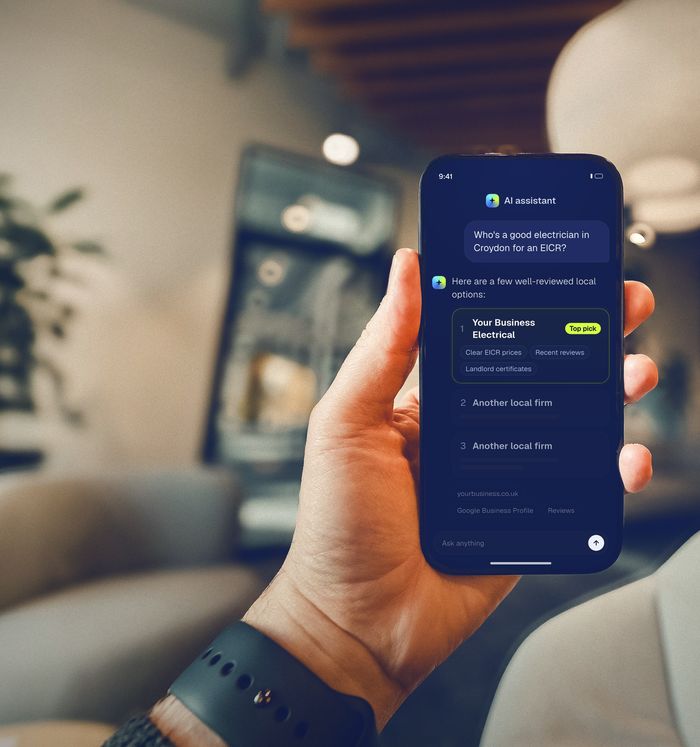
Reviews also feed AI answers. When ChatGPT, Gemini or Google’s AI Overviews describe a local electrician as “well reviewed” or “quick to respond”, that language comes from somewhere, and reviews are a big part of it. In the same BrightLocal survey, 40% of consumers said they trust AI platforms to recommend businesses.
The rules first: what you can’t do
Getting this wrong can get reviews removed, your profile restricted, or worse. There are two sets of rules.
UK law
Since 6 April 2025, the Digital Markets, Competition and Consumers Act 2024 has made it automatically unfair, and illegal, to write, commission or publish fake reviews or concealed incentivised reviews. The Competition and Markets Authority (CMA) can enforce this directly, including with fines. Under UK law, a review that was incentivised must make that clear. In practice, for Google reviews, the simpler rule is: don’t incentivise at all.
Google’s rules
Google’s Maps content policy is stricter than the law. It doesn’t allow businesses to:
- offer incentives (payment, discounts, free goods or services) for posting a review, or for changing or removing a negative one
- discourage negative reviews or selectively ask only happy customers (sometimes called “review gating”)
- pressure customers to leave a review on the spot, or ask for specific content in the review
- post reviews from staff, family or anyone with a conflict of interest, or post from multiple accounts
What Google does allow is simply asking customers to leave a review of their genuine experience. That’s the whole system below.
In short: ask everyone, ask neutrally, offer nothing in return, and never write a review yourself.
A simple system that works
Step 1: Get your direct review link
In your Google Business Profile, look for Ask for reviews (or “Get more reviews”). Google gives you a short link that opens the review box directly. Save it in your phone’s text shortcuts and your email signature. You can also turn it into a QR code to put on invoices, certificates’ cover letters or a leave-behind card.
Step 2: Ask everyone, on the day
The best time to ask is just after you’ve finished and tested, while the customer can see the work and is pleased it’s done. Ask every customer, not just the ones you think will be glowing: Google doesn’t allow selective asking, and a few honest four-star reviews look more believable than a wall of perfect ones.
A short verbal ask works well: “If you’ve got a minute later, a Google review really helps a small business like ours. I’ll text you the link.” Then leave it there; don’t stand over them while they write it.
Step 3: Send the link the same day
Use whatever the customer prefers: text, WhatsApp or email. Keep it short and neutral. Don’t ask for five stars or tell them what to mention.
Text or WhatsApp:
Hi [name], thanks for having us today. If you have a minute, we’d really appreciate a Google review of your experience: [review link]. Thanks, [your name], [business name]
Email:
Subject: Thanks from [business name]
Hi [name],
Thanks for choosing us for your [job, e.g. consumer unit replacement]. Your certificate is attached.
If you have a couple of minutes, we’d be grateful if you could leave an honest Google review of your experience. It helps other people in [town] find a trustworthy electrician: [review link]
Thanks again, [your name]
Mentioning the job in your message is fine; asking them to mention it in their review isn’t.
Step 4: Follow up once
If there’s no review after a few days, one friendly reminder is fine. After that, leave it. Repeated chasing is annoying and can feel like pressure.
Step 5: Reply to every review
Reply to every review, good and bad, within a few days. Keep replies short, specific and human, and never include a customer’s address, full name or job details they didn’t share themselves.
For a positive review:
Thanks, Sarah. Glad the new consumer unit’s all sorted and the house is back to normal. Give us a shout if you need anything else.
For a negative review:
Sorry to hear this, Mark. That’s not the experience we want anyone to have. I’d like to put it right. Please call me on [number] so we can talk it through. [Your name]
Stay calm, don’t argue in public, and move the conversation offline. Future customers read your replies as much as the reviews.
Step 6: Deal with fake or abusive reviews properly
If you receive a review that breaks Google’s policies (for example, from someone who was never a customer, or one containing abuse or personal information), flag it through your Business Profile and track the request in Google’s review management tool. Don’t try to get a genuine but negative review removed by offering anything in exchange; that breaks Google’s rules too.
Beyond Google
Customers and AI tools look at more than Google. If you use Checkatrade, TrustATrader, MyBuilder, Rated People, Trustpilot or Facebook, keep those profiles current and follow each platform’s own review rules. Don’t ask the same customer to review you on five sites; pick one main platform (usually Google) and perhaps one trade platform.
Make it a habit
The electricians with the best reviews aren’t usually doing anything clever. They ask every customer, every time. Some simple ways to make it stick:
- Add “send review link” to your job completion checklist, next to issuing the certificate.
- Put the QR code on your invoice template.
- Check your profile weekly and reply to anything new.
- Keep an eye on your count: Google shows the total on your profile.
Frequently asked questions
Can I offer a discount or prize draw for a review?
Not for Google reviews. Google’s policy bans incentives of any kind, including discounts, free work and prize draws, even if the review is honest. UK law also bans incentivised reviews that don’t disclose the incentive.
Can my family or staff leave reviews?
No. Google doesn’t allow reviews based on a conflict of interest, including from current or former employees and family members. Reviews from people with no genuine customer experience are also fake reviews under UK law.
Can I ask customers to mention the service or town in their review?
No. Google’s policy says businesses shouldn’t ask for specific content in reviews. You can mention the job in your own message, but let the customer write whatever they want.
Can I get a bad review removed?
Only if it breaks Google’s policies, for example if it’s fake, abusive, off-topic or contains personal information. Flag it from your profile. If it’s a genuine negative review, reply calmly and professionally; a good reply often reassures future customers more than the review worries them.
How many reviews do I need?
There’s no magic number, but in BrightLocal’s 2026 survey 47% of US consumers said they wouldn’t use a business with fewer than 20 reviews, and 74% only cared about reviews from the last three months. Aim for a steady flow rather than a one-off push.
Sources
- BrightLocal, Local Consumer Review Survey 2026 (US sample of 1,002 adults).
- Google Maps Help, Maps user-generated content policy: prohibited and restricted content.
- Competition and Markets Authority, Fake reviews guidance (CMA208), April 2025.
- GOV.UK, Fake reviews and sneaky hidden fees banned once and for all, April 2025.