
Reviews
Can I ask my customers for a Google review?
Yes. Asking is allowed, and Google says so in its own policy. Paying, discounting or steering what it says is not.
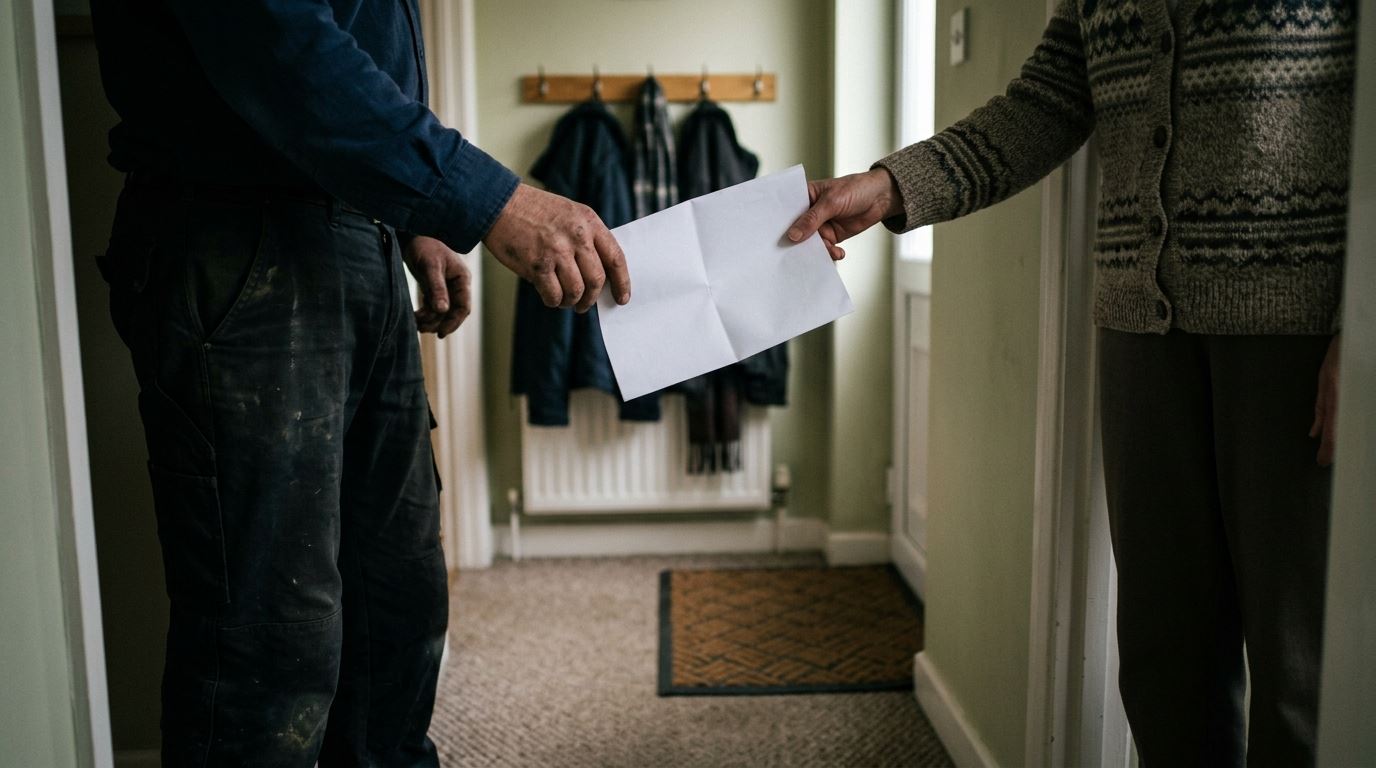
Yes, you can ask
Google's content policy permits this: “Solicit or encourage the posting of content that does represent a genuine experience, without offering incentives to do so or attempting to influence the rating.”
Read the two conditions on the end. Genuine experience. No incentive, no steering the score.
Profile not sorted? Start with getting the profile set up in the first place, then see the rest of the ways sparkies win work.
The rules, in full
The four things GOV.UK says you must not do
Word for word from the CMA's guidance, updated 28 August 2025. Four bullets, one minute.
“do not pretend to be a customer and write reviews about your products or other businesses' products”
“do not commission third parties to write fake reviews – you may be liable for their actions”
“if you are working with a third party – such as a PR, marketing or search engine optimisation (SEO) agency – make sure they also follow these rules”
“do not offer inducements (money or gifts) to customers to write positive reviews about your business”
GOV.UK / CMA, “Reviews: guidance for businesses and agencies”
The law came in on 6 April 2025, under the Digital Markets, Competition and Consumers Act 2024. Fake reviews, and reviews hiding that somebody was rewarded, are banned practices — “Behaviour which falls under a banned practice is automatically unfair and illegal.” Schedule 20, paragraph 13.
GOV.UK says fake reviews “could lead to a substantial penalty or criminal action”, and elsewhere “a fine of up to 10% of global turnover”. That is written for companies with a global turnover, and I have found no CMA case against a one-man trade business. For a sole trader, the consequence you meet is the next section.
Why it matters: the CMA estimates “more than half of UK adults use online reviews”.
The part that hurts
What Google does about it, which is worse
What Google does when it finds fake engagement:
- The profile cannot receive new reviews for a period.
- Existing reviews can disappear for a time.
- A warning can appear on the profile, telling people fake reviews were removed.
The third is the one to worry about. A regulator's fine is an abstraction. A landlord reading that notice while deciding whether to hand you eleven flats is not. Google emails owners first, and there is an appeal.
The three you want to ask about
The awkward ones
Your brother-in-law, your mate, the lad you used to work with
Google does not allow a review “based on a conflict of interest… current or former employment, a contractual or consultory relationship or other professional or personal affiliations.” Family and mates are in that, and the policy also bars pushing staff to “solicit a certain number of reviews”.
“£10 off if you leave me a review”
No, twice over, and the two rules differ. The CMA bans hidden incentives — a review that does not say it was paid for. Google bans the incentive itself, listing as prohibited: “Offer incentives – such as payment, discounts, free of cost goods and/or services – in exchange for posting any review or revision or removal of a negative review”. Owning up does not save you.
“I only ask the ones I know are happy”
Asking only happy customers is not in the four GOV.UK bullets, and not what Schedule 20 paragraph 13 describes. I am not calling it illegal.
Google advises against it — “A mix of positive and negative feedback often feels more trustworthy” — and if your average looks better than your work because of what you left out, you are heading towards what the CMA calls misleading aggregate review information. Risky, not illegal.
Tools are sold to trades that alert you the moment somebody is unhappy, before they post — one was pitched on an electricians' forum in spring 2026 as compliant and not filtering. Judge the practice, not the pitch.
Practical
How to actually ask
Google's own suggestion is simplest: “To leave reviews, you can ask customers to visit a Google link or scan a QR code.” A QR prints on a job sheet or an invoice.
Ask everybody, the same way, every time. Safest, and it works, because it becomes part of finishing a job rather than a favour. In an electricians' forum thread in spring 2026 a poster — the forum lists him as a DIYer, not a sparky — admitted asking only happens when it occurs to them.
And the obstacle nobody warns you about: “Customers must be signed in to a Google Account to leave a review.” That is why half of them never do. Not your fault.
Something you can send
No incentive, no mention of stars.
“Hi Sarah — thanks for having me in today, the consumer unit's tested and the certificate is attached.”
“If you've got a minute, a review on Google helps people round here find me: [link].”
“Either way, give me a shout if anything plays up.”
The bad one
When a bad one lands
Reply. Google's two rules: “Never share the reviewer's private info” and “Be a friend, not a salesperson.” Everyone reading is judging your reply, not the review.
If a review breaks Google's content policies you can report it from your profile. Google does not guarantee it will be taken down. Anyone who says reporting removes a review is selling you something.
And keep it in proportion. Google's own line is that mixed feedback feels more trustworthy. A wall of nothing but five stars is what looks odd.

The bit nobody mentions
If you put reviews on your own website
Put testimonials on your own site and, under the CMA's guidance, you are publishing them. Its list of publishing routes includes websites, and a publisher is expected to take “reasonable and proportionate” steps against fake and hidden-incentive reviews, and to have a published policy.
Before that reads as a reason to panic: “what you need to do in practice depends on factors such as the source of the reviews, the volume of reviews you publish and the risk of fake reviews being contributed.” Six testimonials on a five-page site is not Trustpilot.
One habit covers it: only put up something a real, identifiable customer said, and know where it came from. That rules out the lines that came with the template, and it is why there is not a single review on this site — a made-up one is worse than none.
Questions
Questions sparkies ask
Are you allowed to ask customers for Google reviews?
Yes. Google's policy permits you to “solicit or encourage the posting of content that does represent a genuine experience, without offering incentives or attempting to influence the rating”.
How do I ask a customer for a Google review?
Send a link, or let them scan a QR code — Google's own suggestion. Put the QR on the job sheet.
How do I politely ask customers to leave a review?
Short, once, with the link in it. Thank them, say it helps local people find you, then leave it.
How do I ask for a review without sounding desperate?
Ask everyone, the same way, every time. It sounds desperate when it is singled out.
Can I offer a discount for a review?
No. Google treats incentives in exchange for reviews as fake engagement. GOV.UK says do not offer inducements.
Can I ask a mate or a family member?
No. Google does not allow reviews based on a conflict of interest, which covers employment and personal affiliations.
What happens if I get caught?
The profile stops taking new reviews for a while, existing ones can go, and a warning can appear on it.
Can I only ask the happy customers?
Risky, not illegal — the four GOV.UK bullets do not say it is. It does go against Google's advice on mixed feedback.
Someone left a review who was never my customer — what now?
Report it from your profile if it breaks Google's content policies. Google does not guarantee removal.
Reviews sit inside prominence, one of Google's three local ranking factors. More reviews can help, but: “There's no way to request or pay for a better local ranking on Google.” Nobody sells you a position. For where reviews sit in the whole picture, see the main guide.
Everything quoted is from GOV.UK, legislation.gov.uk and Google's own en-GB pages, read 29 August 2026. Not legal advice — the CMA says the same of its own: “These materials do not constitute legal advice and should not be relied upon as such.”